
Free guide · 2026 edition
U.S. Investor's Guide to Investing in European Football (2026 Edition)
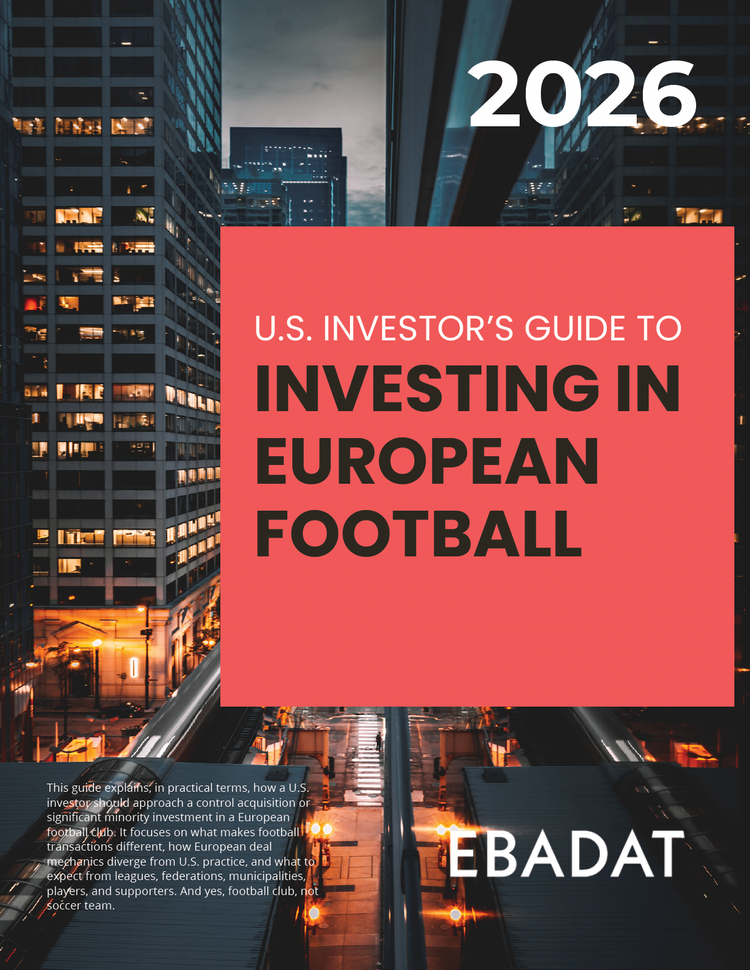
The 2026 U.S. Investor's Guide to Investing in European Football is a free, 81-page guide from Ebadat on how U.S. investors approach a control acquisition or significant minority investment in a European football club. It covers club structures, league and federation approvals, diligence, purchase agreement terms, financing, valuation and post-closing governance, with country coverage of England, Spain, France, Italy, Germany and Luxembourg. Soheil Ebadat, the firm's founder and managing partner, wrote it with contributions from club executives and outside counsel.
Who it is for
Who the guide is for
- High net worth individuals
- Family offices
- Private equity investors
- Strategic investors
The guide is written for sophisticated U.S. investors. Sections 1 through 5 set the strategic and structural context. Sections 6 onward cover execution, including approvals, stadium rights, player economics, diligence, documentation, financing, governance and the first licensing cycle. The appendices map U.S. ownership in European football and summarize recent transactions and regulatory decisions.
Key takeaways
Nine points every U.S. buyer should know
Drawn from the guide's chapters on approvals, diligence, deal terms and financing.
Regulators look past share percentages
Leagues and federations ask who exercises "decisive influence" over a club. Board rights, budget vetoes, funding conditions and side arrangements can all count, so a minority investor can be treated as a controller.
Approvals are the central execution risk
They are iterative and rarely fail outright. More often they are delayed, conditioned or narrowed.
Most deals sign and close separately
League, federation and licensing approvals are conditions to closing, so the signing-to-closing period becomes the deal's center of gravity, and interim covenants, cooperation duties and remedies are no longer secondary.
Stadium rights are core deal documents
Many clubs do not control their ground the way a U.S. investor assumes. Municipal concessions, freehold ownership and groundshares each carry different control, capex, matchday and consent risks.
Price-moving diligence sits in four places
Stadium control and safety; wage, tax and social charge compliance; transfer economics; and debt structures.
Locked box pricing is common in larger control deals
Completion accounts still appear in distressed situations, minority investments and deals with volatile working capital.
European sellers give narrower warranties
Warranty and indemnity policies typically exclude player, regulatory, tax and sporting matters, so targeted indemnities, escrows and price adjustments still do the work.
Common control limits UEFA eligibility
Clubs under common control cannot play in the same UEFA competition in the same season. Multi-club owners need governance separation planned and documented in advance.
Financing has to survive relegation
Regulators prefer durable equity over aggressive leverage and scrutinize shareholder loans and related-party financing.
Country snapshot
League and federation approvals at a glance
How the main approval regimes differ, as summarized in the guide.
| Country | Gatekeeper | What the guide flags |
|---|---|---|
| England | Premier League and EFL | Change-of-control reviews focus on ultimate beneficial ownership and funding transparency, with iterative information requests. In the Premier League, the Owners' and Directors' Test sits alongside further structural scrutiny, including leverage constraints. |
| Spain | LaLiga Economic Control | A buyer can clear ownership review and still be unable to register players if the club's Squad Cost Limit capacity is too low. |
| France | LFP and DNCG | The DNCG is the financial gatekeeper. Where sustainability is not shown, outcomes can include conditions and transfer restrictions. |
| Italy | FIGC, Lega Serie A, Co.Vi.So.C. | Acquisitions of 10% or more of a club's capital are reviewed by the FIGC. No one may hold control or significant influence in more than one Italian professional club. |
| Germany | DFL | Under the 50+1 rule, the parent member club must keep majority voting control of the operating company, subject to limited exceptions. |
Contents
What's inside: 23 chapters
From the investment case through the first licensing cycle under new ownership.
Strategic and structural context
- 01Introduction: why the U.S. investor playbook is differentThe investment case and the five questions every investor must answer.
- 02Club legal forms and ownership structuresWhat the "club" is legally, and why the stadium often sits outside it.
- 03The role of FIFAHow FIFA's transfer and contract rules protect, and constrain, a club's core player assets.
- 04Multi-club ownershipSingle-club versus platform models, UEFA eligibility and development pathways.
- 05What makes European football different from U.S. sportsPromotion and relegation, the transfer market and standalone club economics.
Approvals and country chapters
- 06Navigating league and federation approvalsHow regulators assess control and funding, and where approvals stall.
- 07The Italian football industryGovernance, ownership rules and the investment opportunity in Italy.
- 08Luxembourg as a holding jurisdictionVehicle choice, creditor protections and tax treaty access.
The assets and the risks
- 09Stadium rights and municipal relationshipsThree ownership models and what stadium diligence should produce.
- 10Supporter and political riskHow supporter sentiment and local politics shape approvals and operations.
- 11Player contracts, transfers and economicsSell-ons, add-ons, agents, image rights and the obligations register.
- 12Player recruitment as a driver of returnsAcademy, multi-club and data-driven approaches to player value.
- 13Diligence that actually moves priceThe four places price-moving risk shows up, and the work product to demand.
Documentation, financing and valuation
- 14Purchase agreement and deal mechanicsWhere European sellers now give ground, and how to document it.
- 15U.S. versus European deal normsPricing mechanics, warranties, tax risk, W&I insurance and football-specific drafting.
- 16Financing and lender expectationsAligning lender terms with regulators and building for relegation.
- 17Valuing a European football clubRevenue multiples, revenue quality and the squad as a portfolio.
- 18Minority investments and control without majorityGovernance, downside protection and exits without signaling control.
Execution and after closing
- 19Running the deal: term sheet through closingWhy the term sheet sets the deal, and how to run signing to closing.
- 20Post-signing governance and the first licensing cycleWhat regulators expect from new owners in the first season.
- 21Distressed, enforcement and administration-driven acquisitionsEntry points, regulatory treatment and timing.
- 22Tax and U.S.-specific overlaysCFC and PFIC modeling, sanctions screening and currency risk.
- 23Regulatory outlook and conclusionEngland's move toward an independent football regulator and tighter sustainability enforcement elsewhere.
Appendices. A: the U.S. ownership landscape in European football as of March 2026, recent notable transactions and a UEFA and domestic regulatory snapshot. B: selected sources.
Authors
Authors and contributors
Soheil Ebadat
Soheil Ebadat is the founder and managing partner of Ebadat. His practice focuses on M&A, financings and fund formation, including sports transactions. He earned his J.D. from the University of Chicago Law School.
Kiara Cunningham, an associate at Ebadat, contributed to the research, drafting and development of the guide.
- Jeff LuhnowForeword. Founder of Blue Crow Sports Group and former general manager of the Houston Astros
- Varun DesaiChief Financial Officer, Blue Crow Sports Group: valuing a European football club
- Arvind NarayananCo-founder and Chief Strategy Officer, Blue Crow Sports Group: player recruitment as a driver of returns
- Juan Manuel López RuizOutside sports counsel: the role of FIFA in the club's contractual and operational structure
- Federico Venturi FerrioloOutside counsel in Italy: the Italian football industry
- Euryale DidillonOutside counsel in Luxembourg: Luxembourg as a holding jurisdiction
Contributors from outside Ebadat are not Ebadat attorneys. Their views are their own.
Our practice
Our European football practice
Ebadat advises U.S. investors, sponsors and multi-club platforms on acquiring, selling and structuring stakes in European clubs.
Ebadat Law has carved out a niche as a leading US-based adviser to American investors entering European football ownership.
The Legal 500 United States, Sport
- June 2026
Represented Blue Crow Sports Group in its sale of an 84.21% stake in CD Leganés to 885 Capital, closed June 1, 2026. Read the announcement
- May 2026
Advised Channel Football Group, a founding sponsor of Arise Capital Partners, on the formation and capitalization of its investment vehicle and the acquisition of Sheffield Wednesday Football Club by Arise Capital Partners, closed May 2, 2026. Read the announcement
- October 2025
Advised the outgoing ownership group in the sale of rights associated with MFK Vyškov, a transaction that moved the club's professional competition rights to FK Příbram for the 2025-26 season. Read the announcement
- July 2025
Represented Blue Crow Sports Group in its acquisition of Le Havre Athletic Club (Ligue 1). Read the announcement
- 2025
Served as lead counsel to a U.S. investor consortium on its advanced bid for A.C. Monza (Serie A). The sellers pursued an alternative transaction. Read the announcement
See our sports practice. Prior results do not guarantee a similar outcome.
FAQ
Frequently asked questions
Is the guide free, and do I need to register?
Yes, it is free, and no registration is required. Download the PDF from this page.
Can a minority investor be treated as controlling a club?
Yes. Leagues and federations assess "decisive influence," not just share percentages. Budget controls, vetoes over squad spend, approval rights over player signings or sales, and funding tied to operating covenants can all point to control. The guide recommends limiting consent rights to genuinely extraordinary matters, such as changes to capital structure, related-party transactions, insolvency events and disposals of core assets.
Why do European football deals usually sign and close separately?
League, federation and licensing approvals are conditions to closing, and regulators generally expect the ownership, funding and governance package to be substantially documented before they engage. The purchase agreement is signed first, and closing follows the approvals.
What diligence actually moves the price of a club?
The guide identifies four areas: stadium control and safety; wage, tax and social charge compliance; transfer economics, including sell-ons, add-ons, agent commissions and receivables financing; and debt and football finance structures. It also treats integrity and disciplinary exposure as real diligence.
Can one owner have two clubs in the same UEFA competition?
Not if both clubs are under common control. Clubs under common control cannot participate in the same UEFA competition in the same season. Options planned in advance include staged divestment, governance waterfalls that remove influence at one club, and ring-fencing structures vetted with regulators.
How are European football clubs valued?
Usually by blending methods, led by enterprise value-to-revenue multiples benchmarked against comparable clubs and supported by precedent transactions. Discounted cash flow is less often the primary method because many clubs have volatile revenue and negative operating cash flow. The guide recommends modeling revenue compression in a downside scenario, debt service resilience and regulatory headroom.
How current is the guide?
It reflects law, regulation and market practice as of March 2026. League rules, ownership and stake percentages change often, so verify them during diligence.
Talk to us about a club transaction
Questions about a club acquisition, minority investment or multi-club platform?
Attorney advertising. This page and the guide are for informational purposes only. They are not legal, tax, financial or investment advice and do not create an attorney-client relationship. Prior results do not guarantee a similar outcome. Contributors from outside Ebadat are not Ebadat attorneys. References in the guide to clubs, investors and transactions are illustrative and, except as stated on this page, do not imply that Ebadat represented any party. Responsible attorney: Soheil Ebadat, Houston, Texas.